Example 8
The work developed in [1] presents a multiscale 3D chemotaxis assay by combining high-throughput 3D bacterial tracking with microfluidically created chemical gradients. The authors study a large dataset of 3D trajectories of bacteria, analysing statistical properties of the ensemble.
This example shows how to use yupi in order to inspect the dataset of the aforementioned work. It focuses on reproducing some of the figures of the original paper focusing on showcasing yupi API for data processing and visualization for the case of 3D trajectories.
- The example is structured as follows:
Note
You can access the script of this example on the yupi examples repository.
1. Import dependencies
import tarfile

import matplotlib as mpl
import matplotlib.pyplot as plt
import numpy as np
from mpl_toolkits.mplot3d.art3d import Line3DCollection
from pathlib import Path

from utils.binner import Binner

from yupi.core import JSONSerializer
from yupi.graphics import plot_3d, plot_angles_hist
from yupi.stats import collect
2. Uncompress and load the dataset
We downloaded the original dataset from here Then, we converted it into yupi trajectories while keeping just a subset of the whole dataset which we stored in the ecoli_trajs.tar.zx file. We can load the trajectories as:
tar = tarfile.open('resources/data/ecoli_trajs.tar.xz', 'r:xz')
tar.extractall(".")
all_trajs = []
bulk_trajs = []
for file in Path().glob("Ecoli*.json"):
    _loaded_trajs = JSONSerializer.load_ensemble(str(file))
    all_trajs.extend(_loaded_trajs)
    if "bulk"in file.name:
        bulk_trajs.extend(_loaded_trajs)
3. Plot trajectories
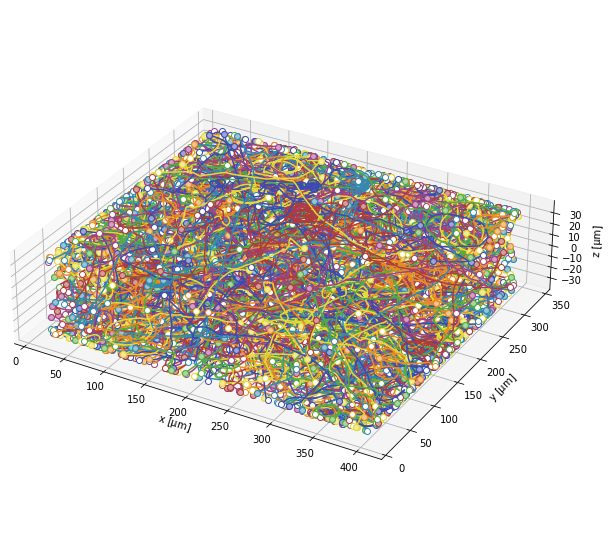
We can easily inspect the trajectories in a single plot, partially reproducing the Figure 1b of the original paper:
plt.figure(figsize=(14, 10))
ax = plot_3d(all_trajs[:2000], legend=False, units='$\mathrm{\mu m}$', show=False)
ax.set_box_aspect((400, 350, 100))
4. Inspecting a single trajectory
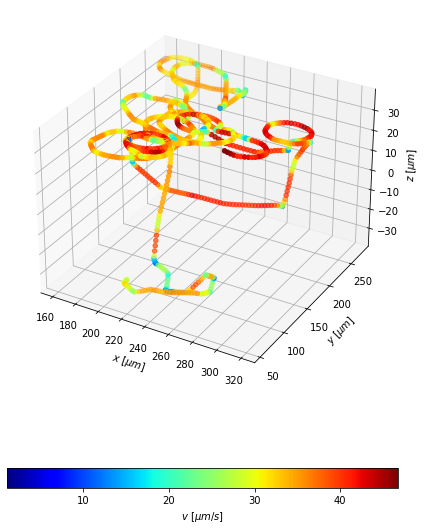
plt.figure(figsize=(14, 10))
traj = all_trajs[1057]
lbls = '${}~[{}]$'

ax = plt.axes(projection='3d')
x = ax.scatter(traj.r.x, traj.r.y, traj.r.z, c=traj.v.norm, cmap='jet')
plt.colorbar(x, location='bottom', label=lbls.format('v', '\mu m/s'), shrink=.5)
ax.update({f'{n}label': lbls.format(n, '\mu m') for n in 'xyz'})
plt.show()
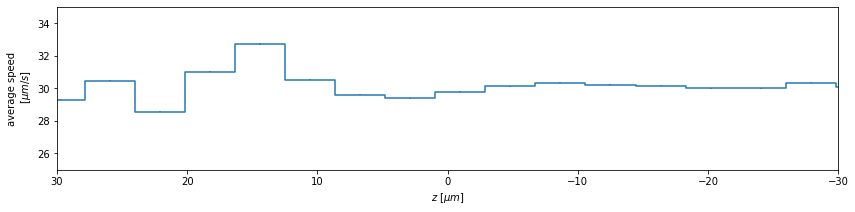
5. Analysis of the velocity distribution according to z-axis position
fixed_trajs = [traj.copy() for traj in all_trajs]
for traj in fixed_trajs:
    traj.rotate_3d(np.pi, (0, 1, 0))
z = collect(fixed_trajs, func=lambda r: r.z)
v = collect(fixed_trajs, velocity=True, func=lambda v: v.norm)

bn = Binner(z, v, count=22)
plt.figure(figsize=(14, 3))
ax = plt.subplot()
plt.errorbar(bn.center_bins, bn.y_binned_mean, yerr=bn.y_binned_sem, drawstyle='steps-mid')
plt.ylim(25, 35)
plt.xlim(-30, 30)
ax.invert_xaxis()
plt.xlabel(lbls.format('z', '\mu m'))
plt.ylabel('average speed\n' + lbls.format("", '\mu m/s'))
plt.show()
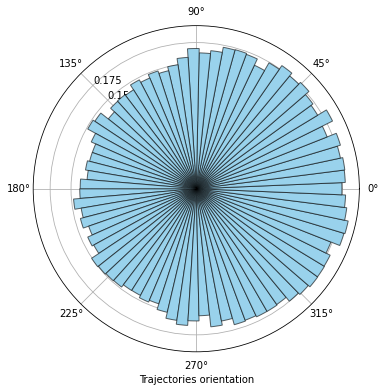
6. Computing angles
fixed_bulk_trajs = [traj.copy() for traj in bulk_trajs]
for traj in fixed_bulk_trajs:
    traj -= traj.r[0]
    traj.rotate_3d(np.pi, (0, 1, 0))

plt.figure(figsize=(10, 6))
xy_vel = collect(fixed_bulk_trajs, func=lambda v: v[:,:2], velocity=True)
angles = np.array([np.arctan2(v[1], v[0]) for v in xy_vel])
ax = plot_angles_hist(angles, bins=75, show=False)
ax.set_theta_zero_location("E")
plt.xlabel("Trajectories orientation")
plt.show()
7. References
[1] Grognot, M., & Taute, K. M. (2021). A multiscale 3D chemotaxis assay reveals bacterial navigation mechanisms. Communications biology, 4(1), 1-8.